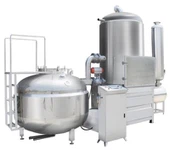
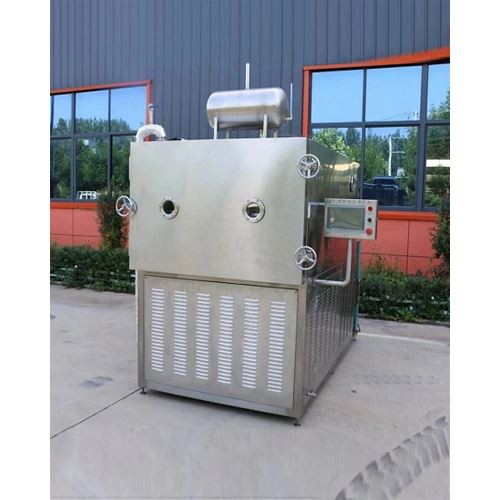
Pilot Production Freeze Dryers bridge laboratory formulation and full-scale industrial manufacturing. Engineered for process optimization, clinical trial batch production, and small-batch commercial processing, these systems provide precise thermal control and vacuum dynamics required for sensitive biologicals, pharmaceuticals, and high-value compounds.
Constructed to meet cGMP standards and supported by recognized certifications (CE, ASME, and ISO 9001), this equipment ensures seamless scale-up validation, allowing process engineers to transfer recipes directly to large-scale production freeze dryers without thermal or mass-transfer deviations.
Product Range & Specifications
|
Model |
Shelf Area (m2) |
Ice Condenser Capacity (kg/batch) |
Min. Condenser Temp. |
Primary Application |
|
PPFD-05 |
0.5 |
10 |
<= -50 deg C / -80 deg C |
Process optimization & small clinical lots |
|
PPFD-10 |
1.0 |
20 |
<= -50 deg C / -80 deg C |
Pilot batch manufacturing |
|
PPFD-20 |
2.0 |
40 |
<= -80 deg C |
Scale-up verification & mid-scale production |
|
PPFD-30 |
3.0 |
60 |
<= -80 deg C |
High-density clinical manufacturing |
Technical Specifications
Chamber Material: 316L stainless steel interior with electropolished finish (Ra <= 0.4 um).
Shelf Temperature Control: Silicone oil circulation medium; temperature range from -50 deg C to +70 deg C (+/- 1.0 deg C uniformity).
Condenser Performance: External side-mounted or rear-mounted condenser configuration to minimize vapor flow resistance; defrost via sanitary steam or hot water.
Vacuum System: Dual-stage rotary vane roughing pump paired with a roots blower; ultimate vacuum < 1.0 Pa (clean, dry chamber).
Control Architecture: Siemens PLC integrated with a 15-inch industrial touch panel; 21 CFR Part 11 compliant data logging, audit trail, and multi-level password security.
Utilities Required: 380V/440V, 3-phase, 50/60Hz; purified water (WFI) for cleaning; clean steam for sterilization (optional).
Applications
Pharmaceuticals: Injectable vials, vaccines, monoclonal antibodies, and live viral vectors requiring strict moisture content control (< 1.0%).
Biotechnology: Diagnostic reagents, enzymes, blood plasma fractions, and specialized proteins.
Advanced Materials: Nanoparticles, catalysts, and polymers requiring controlled porous structures.
Nutraceuticals & Botanicals: High-purity extracts, probiotics, and bioactive peptides sensitive to thermal degradation.
Applications
Pharmaceuticals: Injectable vials, vaccines, monoclonal antibodies, and live viral vectors requiring strict moisture content control (< 1.0%).
Biotechnology: Diagnostic reagents, enzymes, blood plasma fractions, and specialized proteins.
Advanced Materials: Nanoparticles, catalysts, and polymers requiring controlled porous structures.
Nutraceuticals & Botanicals: High-purity extracts, probiotics, and bioactive peptides sensitive to thermal degradation.
Selection Guide
Selecting the appropriate pilot freeze dryer requires evaluating four primary operational metrics:
Batch Volume & Vial Density: Calculate total product volume per batch to determine required shelf area (m2) and vial loading configuration.
Sublimation Rate & Condenser Capacity: Ensure the condenser capacity exceeds the total ice mass removed per batch by at least 20% to prevent choking.
Eutectic Point Analysis: Verify that the refrigeration system can achieve and maintain temperatures safely below the product's eutectic or collapse temperature during primary drying.
Regulatory Integration: Confirm whether clean-in-place (CIP) and sterilization-in-place (SIP) utility connections match facility infrastructure.
Customization Options
Stoppering Mechanism: Hydraulic or pneumatic stoppering systems for vial sealing under vacuum or inert gas backfill.
Containment Integration: Isolator or restricted access barrier system (RABS) compatible door configurations for toxic or sterile compounds.
Isolation Valves: Pneumatic isolation valve between drying chamber and condenser to facilitate rate-of-rise pressure testing and endpoint determination.
Refrigeration Configurations: Dual compressor cascade systems using environmentally compliant HFO/HFC refrigerants.
Quality Control & Compliance
Material Traceability: Mill test certificates (MTCs) provided for all product-contact stainless steel components.
Welding Inspection: 100% radiographic or dye-penetrant testing on all vacuum chamber and pressure-retaining welds.
Surface Roughness Verification: Mechanically measured and certified Ra values on shelves and chamber walls.
Factory Acceptance Testing (FAT): Rigorous operational testing including helium leak detection, temperature mapping across all shelves, and ultimate vacuum pull-down verification prior to shipment.
Packaging & International Shipping
Crating: ISPM 15-compliant heat-treated wooden crates with internal shock-absorbing mounts and moisture-barrier vacuum sealing.
Component Protection: Electrostatic discharge (ESD) protection for control panels; sanitary ports sealed with blind flanges and Tri-clamp caps.
Documentation Package: Complete documentation binder including FAT reports, electrical schematics, piping and instrumentation diagrams (P&ID), and material certificates included inside the crate.
Technical Support & After-Sales Service
Documentation & Validation: Comprehensive IQ/OQ protocol packages supplied to support site qualification.
Remote Diagnostics: Secure ethernet interface for remote troubleshooting and software updates by application engineers.
Spare Parts Availability: Critical wear components (vacuum pump maintenance kits, door gaskets, and valve diaphragms) stocked for dispatch within 48 hours.
On-Site Services: Professional installation supervision, commissioning assistance, and operator training conducted by factory-certified technicians.
Frequently Asked Questions
Hot Tags: pilot production freeze dryer, China pilot production freeze dryer manufacturers, suppliers, factory, compact freeze dryer, Industrial Large Vacuum Freeze Dryer, large freeze dryer, Pet Food Freeze Dryer, rotary freeze dryer, vacuum freeze dryer