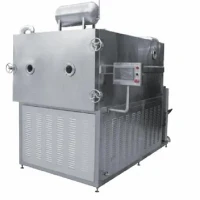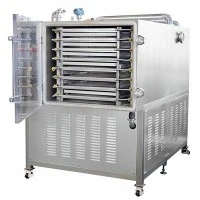
Compact vacuum freeze-drying equipment integrates refrigeration, deep-vacuum, radiant heating, and programmable logic control into a single skid footprint. Engineered for pilot plants, R&D laboratories, and small-batch production, these systems execute primary and secondary sublimation cycles under closed-loop parameters.
Constructed with 304/316L stainless steel product contact zones and sanitary Tri-clamp connections, the architecture withstands full vacuum and supports clean-in-place (CIP) operations.
Product Range
|
Model Series |
Shelf Area (m2) |
Condenser Capacity (kg/batch) |
Ice Condenser Temp (°C) |
Primary Application |
|
CFD-05 |
0.5 |
6 |
<= -50 / <= -80 |
R&D Laboratories, Formulation Trials |
|
CFD-20 |
2.0 |
25 |
<= -50 / <= -80 |
Pilot Plant Scale, Botanical Extracts |
|
CFD-50 |
5.0 |
60 |
<= -50 / <= -80 |
Small-Batch Production, Specialty Pharma |
Technical Specifications
|
Parameter Category |
Specification / Metric |
Engineering Standard & Details |
|
Temperature Control |
Shelf Temperature Range |
-40°C to +65°C (Precision: ±1.0°C) |
|
Condenser Ultimate Temp |
<= -50°C (Standard) / <= -80°C (Low Eutectic Option) |
|
|
Vacuum Performance |
Ultimate Vacuum Pressure |
<= 5 Pa (Clean, empty chamber) |
|
System Leak Rate |
<= 10^-3 Pa·m3/s (Helium mass spectrometer verified) |
|
|
Material & Construction |
Product Contact Surfaces |
Mirror-polished 316L Stainless Steel (Ra <= 0.4 μm) |
|
Chamber Structure |
304/316L stainless steel; internal fluid circulation channels |
|
|
Control & Automation |
PLC Architecture |
Siemens PLC + Industrial Touchscreen (100+ recipe storage) |
|
Data Compliance |
21 CFR Part 11 audit trails and secure batch data export |
|
|
Refrigeration & Vacuum |
Compressors & Pumps |
Hermetic/Semi-hermetic compressors; Two-stage oil-sealed pumps |
|
Refrigerants |
Eco-friendly (R404A, R507, or cascade R23 options) |
|
|
Utilities & Power |
Power Supply |
3-Phase, 380V/480V, 50Hz/60Hz |
|
Pneumatics & Cooling |
Compressed air (>= 0.6 MPa); Chilled water or air-cooled condenser |
Applications
Pharmaceuticals & Biotechnology: Lyophilization of diagnostic reagents, peptides, live vaccines, and heat-sensitive APIs in vials or ampoules.
Nutraceuticals & Botanicals: Preservation of herbal extracts, probiotics, and enzyme formulations requiring bio-activity retention.
Specialty Food Processing: Small-scale production of high-value meal components, coffee concentrates, and functional ingredients.
Material Science: Dehydration of porous nanomaterials, polymers, and chemical catalysts without structural collapse.
Selection Guide
Evaluate the following operational parameters prior to equipment specification:
Batch Mass & Water Load: Calculate total ice mass per batch based on initial moisture versus target residual moisture (<= 1% to 3%). Ensure condenser capacity exceeds water load by >= 20%.
Eutectic Point Analysis: Products featuring low eutectic points (< -40°C) necessitate -80°C condenser temperatures paired with silicone oil loops.
Container Format: Vials require bottom-up stoppering mechanisms (hydraulic or pneumatic). Bulk drying requires open stainless steel trays with direct thermal conduction.
Utility Verification: Confirm facility readiness for 3-phase power, compressed air (>= 0.6 MPa), and dedicated cooling water or ventilation.
Customization Options
Stoppering Mechanism: Pneumatic or hydraulic bottom-up vial stoppering inside the chamber under vacuum or inert gas.
CIP/SIP Integration: Spray balls, internal piping loops, and steam-sterilizable diaphragm valves.
Inert Gas Backfill: Automated nitrogen or argon purging prior to chamber unloading and sealing.
Isolation Integration: RABS (Restricted Access Barrier Systems) or isolator compatibility for sterile handling.
Quality Control
Material Traceability: Mill test certificates (MTCs) supplied for 304/316L pressure vessels.
Welding Inspection: TIG welding executed by certified technicians; 100% radiographic (RT) or dye penetrant (PT) testing on vacuum seams.
Pressure Testing: Hydrostatic testing executed at 1.5x design pressure prior to passivating.
Factory Acceptance Testing (FAT): Pre-shipment operational verification covering vacuum drawdown, temperature uniformity (via multi-channel thermocouples), and refrigeration pull-down rates. IQ/OQ protocols included.
Packaging & International Shipping
Crate Construction: ISPM 15-compliant fumigated plywood boxes lined with moisture-barrier foil bags and desiccant.
Component Protection: Instrumentation, gauges, and pumps decoupled and shock-mounted with EPE foam.
Documentation Inclusion: Waterproof packaging containing operation manuals, electrical schematics, P&ID diagrams, and calibration certificates.
Technical Support & After-Sales Service
Commissioning: Remote digital setup guidance or on-site engineer dispatch for physical hookup and trial runs.
Spare Parts: Critical wear items (pump oil, shaft seals, door gaskets, solenoid valves) stocked for 48-hour dispatch.
Remote Diagnostics: Secure Ethernet port integrated into the PLC panel for remote troubleshooting and parameter optimization.
Frequently Asked Questions
Hot Tags: compact vacuum freeze-drying equipment, China compact vacuum freeze-drying equipment manufacturers, suppliers, factory, freeze vacuum dryer, fruit freeze dryer machine, large freeze dryer, Pet Food Freeze Dryer, vacuum food dryer, vacuum freeze dryer