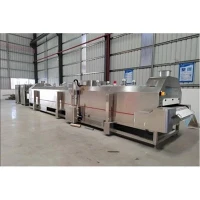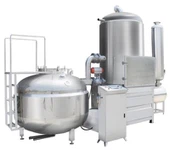

Continuous production freeze dryers replace traditional batch-tray processing with uninterrupted, steady-state lyophilization. Engineered for high-throughput manufacturing, these systems integrate automated feeding mechanisms, multi-zone temperature-controlled heating platens, internal ice condensers, and differential pressure air-lock discharge assemblies operating under high vacuum (< 10 Pa).
Unlike static batch units that require manual loading, extended thermal ramping, and individual cycle validation, continuous architectures maintain constant sublimation rates. This eliminates thermal history variance between batches, stabilizes residual moisture content, and supports 24/7 industrial production lines.
Product Range
|
Model Series |
Water Evaporation Capacity |
Primary Feed Mechanism |
Target Processing Volume |
|
CFD-100 |
100 kg/h |
Multi-tier stainless steel conveyor belt |
Mid-scale functional foods, probiotics |
|
CFD-300 |
300 kg/h |
Continuous rotary drum / tray feed |
Bulk pharmaceuticals, herbal extracts |
|
CFD-500+ |
500-1000 kg/h |
Dual-line modular vacuum lock system |
Industrial instant coffee, high-capacity biotech |
Technical Specifications
|
Technical Parameter |
Specification Standard & Configuration |
|
Operating Vacuum Range |
5 Pa to 50 Pa (Sustained by dual-stage rotary vane pumps and Roots blowers, Leybold/Edwards configurations) |
|
Condenser Temperature |
-50°C to -85°C (Multi-circuit cascade refrigeration system using eco-compliant refrigerants R507/R23) |
|
Shelf / Heating Plate Material |
316L Stainless Steel with internal silicone oil circulation channels; surface roughness Ra <= 0.4 um |
|
Control Architecture |
Siemens S7-1500 PLC paired with WinCC SCADA; 21 CFR Part 11 compliant data audit trails |
|
Electrical Utility |
380V / 480V, 3-phase, 50/60Hz |
|
Cooling Water Utility |
15-25°C supply temperature at 0.3-0.4 MPa pressure |
|
Compressed Air Utility |
0.6-0.8 MPa (Oil-free and instrument-dry) |
Applications
Pharmaceutical & Biotech: Bulk production of antibiotics, enzymes, diagnostic reagents, and active pharmaceutical ingredients (APIs) requiring aseptic design compliance.
Food Processing: Industrial dehydration of instant coffee extracts, nutritional liquid concentrates, dairy hydrolysates, and high-value fruit purees.
Chemical & Material Science: Nanopowders, catalysts, and temperature-sensitive polymers requiring controlled porous morphologies.
Selection Guide
Configuring an industrial continuous freeze dryer requires aligning feedstock rheology with thermodynamic limits. Evaluate parameters using this sequence:
Calculate Evaporation Load: Determine total water removal per hour based on initial solids concentration and target final moisture (< 2%).
Assess Eutectic/Collapse Points: Feedstocks with low collapse temperatures (e.g., high-sugar food extracts) dictate maximum shelf heating limits to prevent structural melt-back.
Define Containment Standards: Specify Clean-in-Place (CIP) and Sterilization-in-Place (SIP) circuits for pharmaceutical lines; automated wash-down manifolds are standard for food-grade processing.
Verify Plant Infrastructure: Confirm facility ceiling height, entry clearances, and electrical load capacity against system footprint dimensions.
Customization Options
Chamber Geometry: Modular chamber lengths and custom seal placement engineered to match existing factory footprints.
Material Upgrades: Product-contact components configurable from standard 316L to Hastelloy C22 for corrosive chemical processing.
Feed and Discharge Interfacing: Customized screw feeders, liquid atomization nozzles, or roller compactors to couple directly with upstream and downstream equipment.
Refrigeration Redundancy: Split-compressor dual circuits designed to eliminate single-point failure risks during continuous campaigns.
Quality Control
Material Traceability: Mill test certificates (MTC) supplied for all pressure vessels and product-contact sheets per EN 10204 3.1.
Pressure Vessel Codes: Chambers fabricated and stamped in accordance with ASME Section VIII Div. 1 or PED 2014/68/EU.
Factory Acceptance Testing (FAT): Every system undergoes a 72-hour pressure decay test, helium mass spectrometer leak detection (sensitivity < 1 x 10^-9 Pa*m^3/s), and refrigeration cascade stress verification prior to crating.
Packaging & International Shipping
Corrosion Protection: Internal vacuum chambers treated with desiccant packs and sealed under dry nitrogen purge.
Crate Construction: ISPM 15-compliant fumigated export wooden crates featuring vibration-isolated mounting skids.
Modular Separation: Refrigeration skids and electrical control enclosures shipped in separate climate-controlled modular crates to prevent transit shock damage.
Technical Support & After-Sales Service
On-Site Commissioning: Supervised mechanical assembly, vacuum tuning, and sensor calibration executed by factory-certified process engineers.
Remote Diagnostics: Secure VPN gateway integrated into the PLC architecture for real-time remote troubleshooting and software diagnostics.
Spare Parts Inventory: Critical wear components-including vacuum pump vanes, shaft mechanical seals, and pneumatic valves-stocked regionally for dispatch within 48 hours.
Frequently Asked Questions
Hot Tags: continuous production freeze dryer, China continuous production freeze dryer manufacturers, suppliers, factory, Food Vacuum Freeze Dryer, Fruit Food Meat Vacuum Freeze Dryer, industrial food freeze dryer, industrial freeze dryer machine, Pet Food Freeze Dryer, rotary freeze dryer