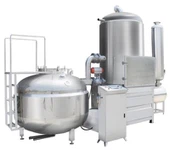
A deep fryer is a device that uses high temperatures to fry food. Its operating principle mainly involves three aspects: heating, heat transfer, and mass transfer.
First, the deep fryer heats the oil in the tank to a suitable temperature, typically between 160°C and 200°C, using methods such as electric heating or flame heating. This allows the food to quickly form a golden-brown, crispy outer shell while locking in internal moisture, preserving its texture and nutrients.
Second, heat transfer refers to the transfer of hot oil to the food surface through conduction, convection, and radiation, rapidly heating it. Conduction refers to energy transfer through direct contact; convection refers to energy transfer caused by the flow of matter in a liquid or gas; and radiation refers to energy transfer generated by electromagnetic wave radiation. These methods interact, allowing the food surface to be quickly heated by the hot oil, forming a crust.
Finally, mass transfer refers to the gradual diffusion of water and other components dissolved in the hot oil into the food over time. This allows the food to be gradually heated internally, achieving a thorough cooking effect.