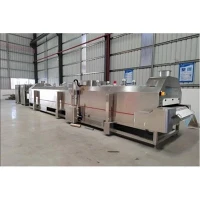
The continuous fryer is the core of any frozen french fries production line and potato chip frying line, and understanding its structure helps buyers judge whether a quoted machine is built for real output rather than a simple tank with a heater. Unlike a batch fryer that loads and unloads by hand, a continuous fryer carries product through oil on a moving belt, keeps oil temperature stable across the whole run, and removes crumbs automatically, which is why it dominates high-capacity potato processing.
The main body consists of an oil tank divided into heating zones, a mesh or flighted conveyor belt that moves product through the oil, heating elements or burners, an oil circulation and filtration loop, an exhaust hood above the oil surface, and a control panel. The belt determines residence time; adjustable belt speed lets the same machine handle thin chips and thicker fries by changing dwell rather than rebuilding the tank. Multi-zone heating lets operators hold different temperatures along the path, which matters because chips and fries need rising temperature curves rather than one flat setting.
Oil circulation keeps temperature even and carries crumbs to the filter; without it, hot spots burn product and aged oil darkens every batch. The exhaust hood removes steam and fumes so oil does not foam and the work area stays safe. The control panel records zone temperature, belt speed and oil level, letting operators save recipes and reproduce results.
Our continuous fryer is designed as the shared core of a frozen french fries production line and a potato chip frying line: heavy-duty tank construction resists thermal deformation, the belt and dwell range cover both thin chip slices and thick fry strips, and the filtration loop keeps oil clear during long runs. Buyers often ask whether one fryer can serve two products; our adjustable zones and belt speed make that possible without a second machine.
When comparing quotes, inspect zone count, heating recovery after loading, filtration method and belt adjustment range, because these decide real frying performance, not tank size. Contact us for a fryer layout matched to your target capacity and product mix.