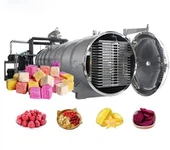
Vacuum freeze‑drying adopts sublimation drying under low‑temperature and high‑vacuum environment. Compared with traditional hot‑air drying, spray drying and other thermal processing technologies, its energy consumption level is relatively higher. Many factory operators form a fixed mindset that energy consumption is completely determined by equipment brand and model, and there is little room for optimization in later‑stage production. In actual mass production practice, the operation habits of on‑site workers, material pretreatment status, loading mode, freeze‑drying curve setting and daily maintenance status will produce very obvious influence on power consumption per kilogram of finished products.
Material loading density and laying mode are the most direct influencing factors. Excessive loading thickness or over‑stacking will block the escape channel of water vapor, prolong sublimation drying cycle greatly, and continuously increase the working time of refrigeration system and vacuum pump, resulting in sharp rise of power consumption. On the contrary, if the material tray is only partially filled, the utilization rate of freeze‑dryer cavity drops severely. Though single‑batch drying time is shortened, the output per unit time is low, which also pushes up comprehensive energy consumption of each kilogram of products. Operators need to control uniform material thickness, keep reasonable gaps between materials, ensure smooth heat transfer and water vapor diffusion, and maximize effective loading capacity of equipment under the premise of guaranteeing drying quality.
Pre‑freezing procedure is the foundation of whole freeze‑drying craft, which has non‑ignorable impact on total energy consumption. If pre‑freezing temperature is not low enough or holding time is insufficient, internal moisture of material cannot be completely converted into solid ice. Partial melting phenomenon will occur in the sublimation phase. Melted moisture will destroy original porous tissue structure of freeze‑dried goods, and the re‑freezing of liquid water will bring extra energy loss. However, blindly pursuing ultra‑low pre‑freezing temperature is also undesirable. Excessively low temperature will consume large amounts of refrigeration power without bringing additional benefit to product quality. Different raw materials including fruits, vegetables, meat and dairy products have different eutectic points. Operators should set targeted pre‑freezing temperature and holding time according to material eutectic point characteristics, to achieve complete freezing effect with minimum energy input.
Besides loading and pre‑freezing, daily maintenance of core components cannot be neglected. Condenser is responsible for capturing water vapor sublimated from materials. When surface accumulates thick frost layer, heat exchange efficiency will drop obviously. Vacuum pump, sealing rings and door gasket directly decide vacuum degree inside chamber. Aging, wear and dirt accumulation of sealing elements will cause vacuum leakage. In order to maintain set vacuum level, vacuum pump has to run with higher load, which brings continuous extra power waste. Regular defrosting, cleaning of condenser, inspection and replacement of aging sealing accessories can keep equipment working under high‑efficiency state.
Enterprises are suggested to establish complete production data archives. Record pre‑freezing parameters, sublimation temperature, processing duration, actual power consumption and finished product quality index for each batch of different raw materials. Gradually summarize mature and stable process curves for each material. Avoid repeated exploratory debugging in every production batch. Standardized and solidified operation procedures can steadily reduce unit energy consumption of freeze‑dried products. For long‑term factory operation, fine‑grained energy consumption management will bring continuous cost‑reduction benefit and strengthen market competitiveness of final freeze‑dried food.