
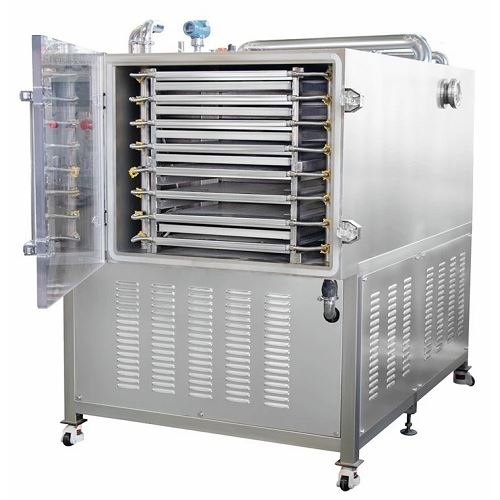
Small-Scale Production Lyophilizers are designed for pilot-scale and low-volume freeze-drying applications, bridging laboratory freeze dryers and larger production systems. The listed configurations cover batch capacities from 10 kg to 50 kg per 24 hours, with shelf areas from 0.5 m² to 3.0 m².
The systems are intended for applications including pharmaceuticals, biologics, APIs, diagnostic reagents, nutraceuticals, and fine chemicals. Available configurations include controlled shelf temperature, vacuum systems, vial stoppering, PLC and industrial PC control, and optional CIP/SIP integration.
Product Range
|
Model |
Ice Condenser Capacity |
Shelf Area |
Shelf Temperature Range |
Primary Application |
|
LYO-10SP |
10 kg / 24 h |
0.5 m² |
-50°C to +70°C |
Diagnostic reagents, peptide R&D |
|
LYO-30SP |
30 kg / 24 h |
1.5 m² |
-70°C to +70°C |
Clinical trial pharmaceuticals, APIs |
|
LYO-50SP |
50 kg / 24 h |
3.0 m² |
-80°C to +70°C |
Pilot-scale biologics, vaccines, enzymes |
Technical Specifications
|
Specification |
Configuration / Performance |
|
Condenser Temperature |
≤ -55°C standard; ≤ -80°C optional cascade refrigeration |
|
Product-Contact Material |
316L stainless steel for hollow shelves |
|
Shelf Temperature Uniformity |
Within ±1.0°C |
|
Vacuum System |
Dual-stage rotary vane vacuum pumps with Roots blowers |
|
Ultimate Vacuum Pressure |
< 1 Pa within 30 minutes |
|
Stoppering |
Hydraulic or pneumatic bottom-up vial stoppering |
|
Control System |
Siemens PLC + industrial PC |
|
Data Functions |
Audit trails, multi-level access control, real-time trend logging |
|
Control Software |
Stated in the original specification as compliant with 21 CFR Part 11 |
Key Configuration Features
Controlled Shelf Temperature
The 316L stainless steel hollow shelves use internal fluid circulation for temperature control. The stated shelf temperature uniformity is within ±1.0°C.
Vacuum System
The vacuum configuration combines dual-stage rotary vane vacuum pumps with Roots blowers. The stated ultimate vacuum pressure is below 1 Pa within 30 minutes.
Vial Stoppering
Hydraulic or pneumatic bottom-up stoppering is available for vial processing, with adjustable pressure feedback for closure control under vacuum.
Control and Data Logging
The system uses a Siemens PLC and industrial PC control architecture with real-time trend logging, multi-level access control, and audit-trail functions.
Applications
Pharmaceuticals and Biologics
Suitable applications listed for the equipment include monoclonal antibodies, live-attenuated vaccines, therapeutic proteins, and sterile injectables.
Active Pharmaceutical Ingredients
The systems can be configured for low-volume processing of heat-sensitive chemical compounds and synthetic peptides.
Diagnostic Reagents
Applications include PCR-related reagents, in-vitro diagnostic enzymes, and antibody-coated microspheres.
Nutraceuticals and Fine Chemicals
Potential applications include botanical extracts, probiotic biomass, and specialty reference standards.Application suitability depends on the formulation, required product temperature, water or solvent load, container format, and freeze-drying cycle.
Selection Considerations
Batch Load
Determine the total water or ice load expected during each batch. The original specification recommends selecting a condenser capacity at least 20% above the calculated maximum load.
Product Eutectic or Collapse Temperature
The product's thermal characteristics affect condenser and shelf-temperature selection. For formulations with a eutectic temperature below -40°C, the original specification recommends an -80°C condenser and silicone-fluid cooling system.
Vial or Bulk Processing
Vial processing requires an appropriate stoppering configuration. Bulk tray processing uses smooth-finish 316L trays without vial sealing mechanisms.
Facility and Installation Requirements
For clinical-trial or commercial manufacturing environments, the original specification identifies through-wall installation and double-door barrier configurations as available design considerations.
Customization Options
Chamber Configuration
Available configurations include rectangular chambers with internal mirror-polished 316L stainless steel surfaces, with a stated surface roughness of Ra ≤ 0.4 µm, as well as cylindrical configurations.
CIP and SIP
Automated Clean-in-Place spray balls and Sterilization-in-Place pure-steam ports can be integrated where required by the process configuration.
Refrigeration
Refrigeration configurations can use HFC/HFO refrigerant blends specified in the original product information.
Exhaust Filtration
Dual HEPA/PTFE exhaust filtration can be incorporated for vacuum-pump protection and applications requiring containment considerations.
Customization should be matched to the product formulation, processing method, facility utilities, and applicable regulatory requirements.
Quality and Testing Information
The original specification identifies the following quality-control provisions:
Material Traceability
Mill test certificates (MTCs) are specified for product-contact 316L stainless steel components, including sheets, piping, and flanges.
Welding and Leak Testing
Orbital TIG welding is specified for process piping. Vacuum chamber welds are stated to undergo helium leak testing to < 1 × 10^-9 Pa·m³/s.
Factory Acceptance Testing
The specification states that each unit undergoes a 72-hour continuous factory run test, including temperature mapping, vacuum pull-down performance, and pressure-hold measurements before crating.
Packaging and International Shipping
The listed export packaging configuration includes:
Export Crating: ISPM 15-compliant solid wood crates with internal shock-absorbing mounts and moisture-barrier vacuum foil wrapping.
Component Protection: Refrigeration lines are nitrogen-charged and sealed, while sensitive electronic displays and sensors are protected against shock.
Documentation: The listed shipping documentation includes bills of lading, packing lists, certificate of origin, electrical schematics, and individual instrument calibration certificates.
The final packaging and documentation package should be confirmed according to the destination country and project requirements.
Frequently Asked Questions
Hot Tags: small-scale production lyophilizer, China small-scale production lyophilizer manufacturers, suppliers, factory, compact freeze dryer, freeze drying with a vacuum chamber, fruit freeze dryer machine, industrial freeze dryer machine, rotary freeze dryer, vacuum food dryer


