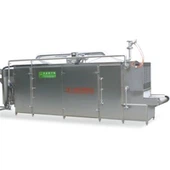
After startup, the material is placed in the material tank for freezing. The freezing process involves two aspects: firstly, a vacuum system removes some moisture by drawing a vacuum; secondly, as the material freezes, some water molecules are forced to the surface and freeze. Once the freezing requirement is met, a heating system heats and dries the material, drawing a vacuum to remove any remaining moisture, which is then carried to the freeze trap to freeze, thus achieving the freeze-drying requirement.
Freeze-drying refers to the process of removing water or other solvents from frozen biological products through sublimation. Sublimation refers to the process where a solvent, such as water, like dry ice, changes directly from a solid to a gaseous state without passing through a liquid state. The product obtained through freeze-drying is called a lyophilizer, and the process is called freeze-drying. Traditional drying causes material shrinkage and damages cells. During freeze-drying, the sample's structure is not destroyed because the solid components are supported by the ice in their place. As the ice sublimates, it leaves pores in the dried residue. This preserves the integrity of the product's biological and chemical structure and its activity. In the laboratory, freeze-drying has many different applications and is indispensable in many biochemical and pharmaceutical applications. It is used to obtain biological materials that can be preserved for long periods, such as microbial cultures, enzymes, blood, and pharmaceuticals, retaining not only their long-term stability but also their inherent biological activity and structure. For this reason, lyophilization is used to prepare tissue samples for structural studies (such as electron microscopy). Lyophilization is also applied in chemical analysis, providing dried samples or concentrating samples to increase analytical sensitivity. Lyophilization stabilizes sample components without altering their chemical composition, making it an ideal analytical aid. Lyophilization can occur naturally. Under natural conditions, this process is slow and unpredictable. Through the development of lyophilization systems, many steps have been improved and refined, accelerating this process.