Vacuum freeze dryers, also known as freeze dryers, have wide applications in many fields. They come in various models and can be classified in multiple ways according to different classification standards.
Classification by Structural Form
Box-type Vacuum Freeze Dryer
This is a relatively common structural form. It typically consists of a freeze-drying chamber, a condenser, and a vacuum pump unit. The freeze-drying chamber is where the materials to be freeze-dried are placed; it is generally a square box structure with multiple shelves inside to support the material trays. These shelves can be temperature-controlled to provide a suitable freeze-drying environment for the materials. The condenser is responsible for capturing the sublimated water vapor and condensing it into ice through the refrigeration system to maintain the vacuum environment during the freeze-drying process. The vacuum pump unit's function is to extract the gas inside the freeze-drying chamber to create the required vacuum level. Box-type vacuum freeze dryers are suitable for freeze-drying various materials, playing a good role in both small-scale laboratory research and pilot-scale production. In the food industry, it can be used to freeze-dry some specialty ingredients, such as fruit slices and diced vegetables; in the pharmaceutical field, it is often used for the freeze-drying production of small batches of pharmaceuticals.
Continuous Vacuum Freeze Dryer
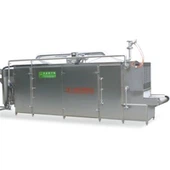
The continuous vacuum freeze dryer features a unique structural design that enables continuous feeding and discharging of materials, significantly improving production efficiency. It typically consists of a feeding system, a drying chamber, and a discharging system. The feeding system continuously transports pre-treated materials to the drying chamber at a controlled speed. The drying chamber contains multiple functional zones where the material undergoes freezing, sublimation drying, and other processes. In the discharging system, the fully dried material is promptly discharged to ensure continuous and stable operation of the equipment. Continuous vacuum freeze dryers offer significant advantages in large-scale production, such as in the industrial production of instant coffee and milk powder. The continuous production method ensures product quality stability and consistency while reducing production costs.
Classification by Working Scale
Experimental Vacuum Freeze Dryer
Experimental vacuum freeze dryers are primarily used for laboratory research. These devices are relatively small in size, simple in structure, and easy to operate and maintain. Their freeze-drying capacity is limited, generally handling small quantities of material, and are typically used for exploring and researching freeze-drying processes for new materials. For example, in the development of new drugs in research institutions, it is necessary to freeze-dry small quantities of samples to determine the optimal freeze-drying parameters, such as temperature, vacuum level, and time. Experimental vacuum freeze dryers can meet this small-scale testing requirement, providing data support and process reference for subsequent pilot-scale and large-scale production. Their internal freeze-drying chamber is small, with limited shelf space, and the configuration of the refrigeration and vacuum systems is primarily designed to meet experimental needs, without requiring excessively high production capacity.
Pilot-Scale Vacuum Freeze Dryer
Pilot-scale vacuum freeze dryers are equipment between experimental and production-scale models. Their processing capacity is significantly improved compared to experimental models, but still relatively small compared to large-scale production equipment. Pilot-scale equipment, with its structure and performance closer to production-scale equipment, serves as a crucial bridge for translating laboratory research results into industrial production. It allows for further scale-up verification of freeze-drying processes established in the experimental phase, examining their stability and feasibility at a larger scale. For example, in the process of pharmaceutical companies moving new drugs from laboratory development to industrial production, pilot-scale vacuum freeze dryers can freeze-dry a certain batch of drugs, verifying the reliability of the production process and providing a basis for equipment selection and production workshop planning.
Production-scale Vacuum Freeze Dryers
Production-scale vacuum freeze dryers are designed for large-scale industrial production. They feature complex structures, powerful functions, and high production capacity. The freeze-drying chambers are large, with extensive and numerous shelves, capable of handling large quantities of material for freeze-drying. The refrigeration and vacuum systems are also more robust to meet the low-temperature and high-vacuum requirements of large-scale production processes. Production-scale vacuum freeze dryers play a key role in large-scale production in various industries, including food, pharmaceuticals, and biopharmaceuticals. In the food industry, it enables the freeze-drying of large quantities of agricultural products to produce high-quality freeze-dried foods; in the pharmaceutical industry, it can be used for large-scale production of freeze-dried medicines, ensuring the quality and supply of medicines.
Classification by Heating Method
Contact Heating Vacuum Freeze Dryer
Contact heating vacuum freeze dryers transfer heat through direct contact between the material and heated shelves, promoting the sublimation of moisture in the material. The heated shelves are typically made of materials with good thermal conductivity, such as stainless steel. During freeze-drying, the material is placed on the shelves, and the heating system heats the shelves to a suitable temperature. Heat is transferred to the material through contact, causing the moisture in the material to gradually sublimate. The advantage of this heating method is its high heat transfer efficiency, which effectively increases the freeze-drying speed. However, it also has certain limitations. For materials with irregular shapes or those that easily stick to the shelves, it may lead to uneven heating, affecting the freeze-drying effect. Contact heating vacuum freeze dryers are widely used in applications where the shape of the material is not critical and rapid freeze-drying is required, such as the freeze-drying of certain chemical raw materials.
Radiation Heating Vacuum Freeze Dryer
Radiation heating vacuum freeze dryers utilize the principle of thermal radiation to heat the material. A radiation heating source, such as an infrared heating lamp, is installed inside the freeze-drying chamber. Radiation-heated vacuum freeze dryers directly irradiate the material surface, causing the material to absorb heat and sublimate its moisture. The advantage of this heating method is its uniform heating, unaffected by the material's shape or placement, ensuring even heating of all parts of the material. For materials requiring high heating uniformity, such as biological products and high-end pharmaceuticals, radiation-heated vacuum freeze dryers are a better choice. However, radiation heating has relatively low efficiency, potentially longer freeze-drying times, and higher equipment costs.
Conduction-Radiation Combined Heating Vacuum Freeze Dryer
Conduction-radiation combined heating vacuum freeze dryers combine the advantages of contact heating and radiation heating. They transfer some heat through contact between the heated shelves and the material, while also utilizing a radiation heating source to radiate heat. This combined heating method can improve heating efficiency and shorten freeze-drying time while ensuring heating uniformity. In practical applications, for materials that have high requirements for freeze-drying quality and efficiency, such as freeze-drying of some precious Chinese medicinal herbs and freeze-drying of special foods, the conduction-radiation composite heating vacuum freeze dryer can give full play to its unique advantages and provide better freeze-drying treatment for materials.