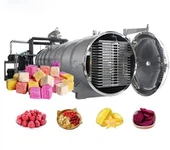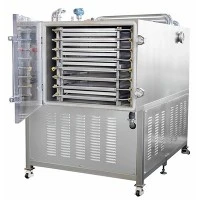
A freeze dryer does something that looks like a trick: it takes a wet product, holds it below freezing for most of a day, and produces something dry, light and crisp without ever letting the water become liquid.
The principle is not complicated. Getting it right on a real product is.
The core idea: sublimation
At normal pressure, heating ice melts it. Reduce the pressure below the triple point of water - 6.11 millibar at 0.01 °C - and the liquid phase disappears from the picture. Heat applied to ice at that pressure does not melt it; it turns it directly into vapour.
That is the whole trick, and it explains why every freeze dryer needs two systems working at once: a vacuum system to get below the triple point, and a refrigeration system to keep the product frozen while heat is applied.
Stage one: freezing
Water in the product becomes ice. The size of the ice crystals decides the pore structure that vapour will travel through for the next twenty hours.
Fast freezing produces many small crystals, a fine pore network, good shape retention and slower drying. Slow freezing produces fewer, larger crystals, larger pores, faster drying, and more damage to cell walls.
Neither is universally right. Fruit for retail usually wants fast freezing; a product where drying time dominates the cost may want slower.
The stage ends with a hold, and the hold has to be long enough for the whole load to reach temperature, not just the probe. A load that is frozen at the surface and liquid at the centre collapses from the inside during drying.
Stage two: primary drying
Chamber pressure drops to roughly 0.05 to 1 millibar. The shelves warm up. The ice sublimates, and the vapour is captured on a condenser held 15 to 20 °C colder than the product.
This is the longest stage, typically 60 to 80 percent of the whole cycle, and it ends when the ice is gone.
One rule governs it: the product temperature has to stay below its collapse temperature. If the frozen matrix softens before it is dry, the structure sags, pores close, and the batch comes out shrunken, glossy and difficult to rehydrate.
Sublimation absorbs about 2,840 kJ per kilogram of ice, and that energy comes from the shelves. The product therefore sits colder than the shelf as long as ice remains - which is why freeze drying is self-limiting, and why it becomes dangerous at the end of the stage, when the ice is gone and the product temperature climbs toward the shelf.
Stage three: secondary drying
Water remains in the product as bound moisture rather than ice. The shelf is raised, often to +30 to +45 °C, and the remaining water is desorbed under vacuum.
Food products finish at 3 to 5 percent moisture. Products where crispness or viability is the point finish lower, sometimes below 2 percent.
This stage is short and it is not optional. A product that feels dry at 8 percent moisture will clump or brown in the bag within weeks.
What is inside the machine
Four systems, and each one can be the limiting factor.
The chamber and shelves: a vacuum vessel with heated and cooled shelves, trays, and a door that seals.
Refrigeration: cools the shelves during freezing, holds the condenser cold through the cycle, and removes the heat that the shelves put in.
Vacuum: a pump plus a condenser, which together keep pressure low while removing a large volume of water vapour.
Control: recipes, trend logging, alarms. On a modern machine this is also the diagnostic tool, because the trend is what shows a leak, a saturated condenser or a collapse.
Why it takes a day and costs more than drying
Removing water by evaporation at 80 °C takes minutes to hours. Removing it by sublimation is limited by how fast vapour can travel through the dried layer, and by how much heat can be delivered without warming the product past its limit.
A production cycle runs 20 to 40 hours depending on the product and the load depth. Refrigeration and vacuum run for the whole of it, which is why energy per kilogram of water removed is several times that of hot air drying.
What that money buys is structure: colour, aroma, shape, crunch, and rehydration in seconds rather than minutes.
What decides quality
Four things, in order. Product temperature against the collapse limit. Layer depth, because vapour resistance rises with it. Condenser performance, because a coil that drifts warm slows the last third of primary drying. And packaging, because the product starts absorbing moisture the moment the door opens.
How JIAXIN sets a cycle
A cycle is not copied from a manual. JIAXIN runs a trial on production equipment with the customer's own product, records the stage timings and the product temperature profile, and issues the recipe with the trend file so the customer can see what each stage actually did.