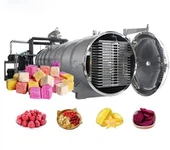
Thin‑walled cells of strawberry and raspberry are fragile. Massive cell damage causes leakage of cell juice and flavor compounds, resulting in fragmentized, sticky and tasteless freeze‑dried goods. For factories producing premium snacks and wagashi raw‑materials, fragments can only be sold at discounted prices and bring considerable profit loss. Japanese high‑end berry processors regard cell‑damage ratio as core quality‑control index. Cell injury is not only generated in sublimation phase; improper handling in pre‑freezing, tray‑transfer and desorption‑drying will also aggravate cell destruction.
First, scientifically manage freezing‑rate and avoid ultra‑fast freezing. Ultra‑rapid freezing produces numerous tiny ice crystals piercing thin‑walled pulp cells and causes irreversible cell injury. In industrial berry production, controlled slow pre‑freezing generates moderately‑sized ice crystals to form sublimation channels while minimizing mechanical piercing damage. However, freezing cannot be infinitely slow; excessive‑slow‑freezing triggers internal water‑migration and tissue damage. Cooling curves shall match berry fruit size.
Second, apply graded‑vacuum sublimation instead of instant extreme‑vacuum pull‑down. If vacuum pump pulls chamber pressure down to ultra‑high vacuum immediately after door‑closing, explosive outward water‑vapor outflow will tear fruit‑cell tissue by huge impact. Graded‑vacuum mode reduces chamber pressure step‑by‑step and enables steady slow vapor diffusion to mitigate cell impact.
Third, physical‑protection for raw‑materials to minimize mechanical stress. Fresh berries are soft and brittle. Even invisible minor collision and squeezing during tray‑loading and transportation create micro‑cell‑damage which only becomes visible as fragmentation after freeze‑drying. Handle trays gently. Use smooth flat trays without sharp protrusions. Spread fruits in single‑layer to reduce squeezing and collision among individual berries. Avoid violent vibration during tray turnover.
Fourth, strict incoming raw‑material grading. Over‑ripe, soft or internally‑bruised berries already have damaged cells inside. Even optimal freeze‑drying processes cannot achieve low‑fragmentation results. Damaged and over‑ripe fruits shall be sorted out for secondary‑grade production and shall not be mixed into premium‑grade batches.
Fifth, avoid steep temperature rise in desorption‑drying phase. Desorption‑drying removes bound water. Fast shelf‑temperature rise creates strong internal thermal‑stress and tears already‑brittle dried‑pulp and causes fragmentation. Temperature shall be lifted mildly and gradually to finish dehydration.
Besides, pay attention to equipment cleaning and maintenance. Hard residual debris left on trays will scratch fresh berries and bring hidden injury. Trays must be thoroughly cleaned after each use. Only multi‑dimensional comprehensive control enables stable output of high‑integrity freeze‑dried berries with low cell‑damage ratio.