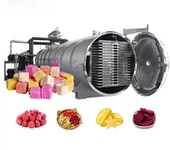
More and more health food, plant extract and probiotic manufacturers choose vacuum freeze-drying, because low-temperature sublimation avoids thermal degradation caused by high-temperature drying. Many buyers simply think that all active substances can be preserved as long as freeze dryers are used. In actual production, unreasonable process parameters will still lead to obvious activity loss.
The first key control point lies in pre-freezing. If the cooling speed is too fast, large ice crystals will not form; tiny ice crystals may pierce cell membranes. After sublimation, cell fluid overflows, leading to oxidation of active ingredients. If freezing is too slow, internal water migration occurs, which also damages tissue structure. Different plant raw materials and microbial strains have suitable freezing speed ranges.
Sublimation stage temperature control is another critical factor. Even under vacuum environment, excessive shelf temperature will produce local hot spots. Heat-sensitive components such as vitamin C, anthocyanin and live probiotics will gradually degrade. Operators need to keep a safe temperature gap between material temperature and eutectic point to prevent melting while guaranteeing sublimation efficiency.
Oxygen contact during drying cannot be ignored. For materials rich in unsaturated fatty acids and polyphenols, long-term exposure to low-pressure air will trigger oxidation. Proper inert gas filling or reasonable vacuum maintenance strategy can slow down oxidation reaction and improve product color and activity retention.
The final desorption drying stage determines residual moisture. Too high residual water will accelerate active substance deterioration during storage. Too long drying time causes unnecessary energy consumption and extra activity loss. Factories need to combine target shelf life to lock the optimal end-point moisture standard.
Stable high activity is the core selling point of high-end freeze-dried products. Fine freeze-drying process control helps manufacturers produce higher-quality goods, support premium positioning and expand high-value overseas market channels.